
HYDRO STATIC POWER GENERATION - DESCRIPTION
“APPARATUS
for and RENEWABLE METHOD of GENERATING ELECTRICITY”
Current hydroelectric power generation
systems are pressed to meet an ever increasing consumer demand,
to meet this demand a conventional approach would involve increasing
the hydroelectric power generation output which in turn would
involve either the construction of further reservoirs complete
with either expensive dams to provide the head of water and/or
unsightly pipelines from existing water sources to serve the power
generators. Typically such reservoirs are in isolated locations
(cost implications) and may involve the flooding of countryside
(environmental impact). It is the object of this apparatus to
develop and bring into operation a less hazardous, environmentally
acceptable with zero impact on wildlife means of generating electricity
making use of a natural renewable energy source at a lower development
cost. |
|
| Principal Air trapped underwater will create an upward force at least equal to the weight of the water it replaces, a condition commonly used to raise large sunken vessels, therefore if a method of introducing air, at atmospheric pressure, to charge a continuous series of submerged containers (Floats) the energy generated from these rising to the surface could be harnessed and adapted to drive machinery. So long as there is a supply of water equal
to, or exceeding, that displaced by the floatation system and
that suitable provision for the disposal of the water discharged
can be made the device would continue to operate indefinitely. |
|
 |
|
| Device Details | |
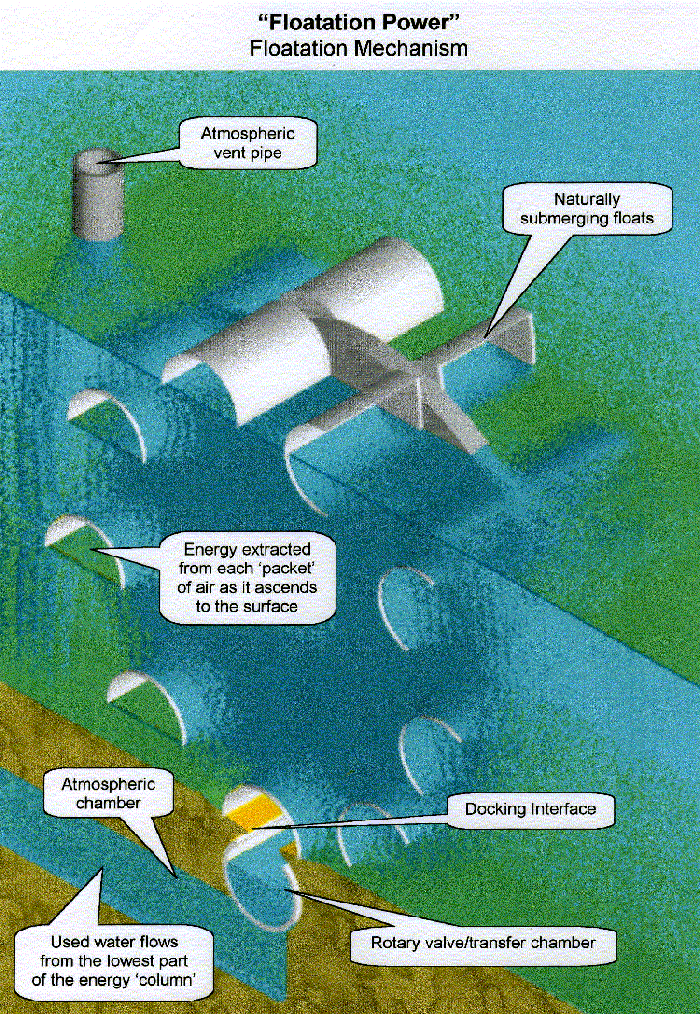
| Atmospheric Chamber | It is envisaged that the device will comprise of a chamber linked to the surface by a suitably sized pipe or shaft to provide a supply of air at from the surface atmospheric pressure. |
| Rotating Valve | The chamber will house as part of its structure a rotating valve (linked to and powered by the floatation operation) allowing the controlled transfer of water into and air out of the chamber. |
| Transfer System | When the rotating valve is driven to the open position the water contained within the docked float above will fall into the rotating valve and the air forced from it will transfer up into a docked float, designed to contain it. |
| Floatation System | The float will now separate from its docked position (pressurising the air) and naturally rise to the surface providing the systems power. This operation will be part of a continuous process with the maximum Power Output of the device being determined, in each location, by the number and size of floats in relation to the depth of water and the amount of water available to be released. |
| Syphonic Discharge | The water discharged from each float into the atmospheric chamber at each revolution of the valve will fall to the base of the chamber, which is designed to contain it, as the water level increases with each discharge a valve will be lifted (by float) allowing the excess water to be drained using a direct or syphonic system to a suitable point down stream. |
| Capacity | The size and number of floats, duplicity of devices operating in sequence will be determined by local conditions allowing flexibility in its use from small domestic to large industrial applications. |
| Location & Siting | The device can be located in any water course, River,
Loch, Lake Etc. so long as a suitable depth of water is available,
there is continuity of supply to match its consumption and a suitable
location is economically available for the syphonic discharge of
water used.
Alternatively the device may be housed within a tank provided with a water supply and discharging directly from the collection chamber by gravity. The device may also be located to make use of waste water being discharged as a by-product from an industrial or manufacturing process, providing an additional or supplementary clean power source. |
| To clarify the above description there is a series of diagrammatic sketches to demonstrate the principal operational stages of this device. See the Diagrams section. | |

Website
© Andrew Bootman