
HYDRO STATIC POWER GENERATION - INTRODUCTION
|
With today’s essential requirement to
meet the ever increasing demand for electricity to operate and
maintain technology both domestically and commercially and with
the diminishing resources of natural fuels, Coal, Oil and Natural
Gas together with the International commitment to reduce Carbon
omissions into our atmosphere (Global Emissions of Greenhouse
Gases - Kyoto Protocol) time is running out for the identification,
development and installation of alternative, renewable and Environmentally
Friendly power sources. |
|
 |
COAL; GAS & OIL POWER GENERATION As well as being finite these traditional fossil fuels (used to generate steam) are subject to high exploration, extraction and transportation costs, are major generators of pollution and are vulnerable to ever increasing market costs, political policies and currently terrorist conditions resulting in spiralling cost increases to the end users as they are depleted. |
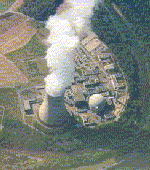 |
NUCLEAR POWER GENERATION Nuclear energy (also used to generate steam) has also fallen out of favour mainly due to the risks associated with its operation and the high costs and long timescales involved in its decommissioning and the safe disposal and/or storage of radioactive waste generated or remaining at the end of their economic life. |
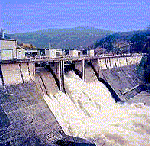 |
HYDRO POWER GENERATION Hydro electrical generation, currently the most environmentally friendly, still requires the construction of large dams and/or the installation long pipelines having a major effect on the environment (flooding of large areas), the manufacture and continued replacement of turbines all of which contribute to the emission of Carbons. |
| All of the above are intrusive
on and have a direct effect (usually detrimental) on the surrounding
environment, they are also highly visible soft targets open to attack
from forces wishing to disrupt the continued functioning of our
electricity dependant society. There are also a number of potential technologies making, or attempting to make use, of natural renewable energy sources to convert to electrical power – i.e. Solar, Wind, Tidal and Wave, Geothermal etc. |
|
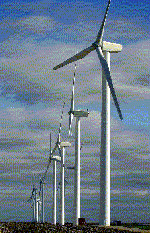 |
WIND POWER GENERATION Wind generation is achieved by erecting groups (Farms) of three bladed turbines mounted on massive structures, noisy in operation, usually visually intrusive to skylines or inshore water locations, the reliability of which is dependant on prevailing winds (no wind no electricity). Again the manufacture and maintenance of the turbines themselves are responsible for carbon emissions into our atmosphere. As an economically viable alternative wind power has still to be demonstrated, indeed it could be concluded that this source of renewable energy is seen as an option simply because no other is currently available. |
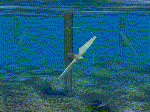 |
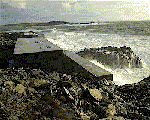
WAVE AND TIDAL ENERGY Wave or tidal action as a renewable and viable alternative power source is a further option, there is no doubt that considerable and reliable natural forces are available to be tapped however the conversion of this natural energy into electricity is proving difficult to economically harness. Sources of power using these methods include underwater bladed turbines (tidal) or the rising and falling of water in an enclosed chamber (Wave). |
 |
|
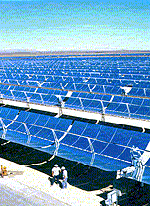 |
SOLAR ENERGY Solar Power for electrical providers requires the concentration of solar energy to provide a heat source, i.e. using Power Tower or Parabolic Trough systems, to power the generation of electricity. This type of Natural energy source is unlimited, subject to solar exposure (less sun less electricity), but still requires the conversion of the heat gathered to be converted into a power source i.e. steam. |
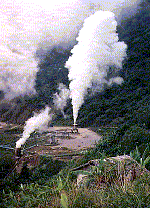 |
GEOTHERMAL ENERGY Geothermal energy is natural earth heat which is present everywhere beneath the Earth surface, although the highest temperature, and thus the most desirable, resources are concentrated in regions of active or geologically young volcanoes. From an engineering point of view geothermal energy may be defined as the useful energy that can be extracted from naturally occurring steam and hot water but of course this depends entirely on availability. |
| There are many other historical
examples of natural (clean & renewable) energy, i.e. Water Wheels
and Windmills etc. however there is another natural power source
which does not appear to have been considered or successfully tapped,
this is the use of Hydro-static power (or a floatation device),
although there are many patents for devices in this area none fully
solve the process.
Hydro-static forces do not primarily involve the movement of water (although it does require a supply/discharge of water) rather they harnesses the energy generated by air released underwater and the forces generated as it travels to the surface (the opposite of the water wheel and the use of gravity). The main problem seems to have been how to solve the introduction an air supply into the system at depth, without expending energy pumping or compressing it, a solution to this is offered by the following device which is both simple and low-tech. |
|

Website
© Andrew Bootman